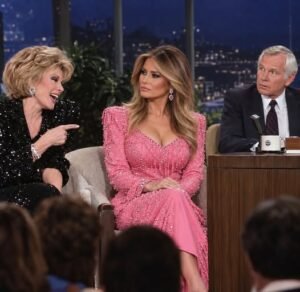
For decades, Dolly Parton has had an unusual ability to walk into a room full of powerful personalities and somehow leave with everyone laughing on her side. She can make fun of herself before anyone else gets the chance, turn an insult into a punchline, and answer uncomfortable questions without appearing angry or defensive. That is exactly why a dramatic story involving Dolly Parton, Joan Rivers, and Johnny Carson has been spreading so widely online.
According to the viral version, Joan Rivers began joking about Dolly’s appearance during an episode of The Tonight Show. At first, Dolly supposedly laughed along as Joan teased her about the towering blond hair, sparkling dresses, exaggerated glamour, and famous figure. Then, the story claims, the jokes became increasingly personal. Eventually Dolly stopped smiling, leaned toward the microphone, and delivered a calm but powerful response about refusing to let anyone confuse her appearance with her intelligence.
It is a perfect story.
Perhaps too perfect.
The dramatic exchange circulating online is explicitly described by at least one version of the story itself as a “fictionalized story inspired by the public personas” of the entertainers involved, rather than a verified television event.
There is, however, a fascinating piece of reality underneath the fiction.
Joan Rivers really did discuss Dolly Parton during an appearance with Johnny Carson. Listings for an October 1982 episode of The Johnny Carson Show specifically say that Rivers talked about subjects including retouched magazine photographs, Gone With the Wind, and Dolly Parton. The listed guests for that episode are Carson and Rivers—not Dolly sitting beside her during the confrontation described in the viral post.
That distinction does not make the viral story less interesting. In fact, it explains why it feels so believable.
Joan Rivers really was famous for saying things other entertainers would never dare say. Her comedy was aggressive, personal, fearless and frequently aimed at celebrity appearances. Nobody was protected simply because they were famous.
Dolly Parton, meanwhile, was almost uniquely equipped to survive that type of humor.
For most of her career, Dolly has understood exactly how people see her. The enormous blond hair, rhinestones, makeup, tight dresses and exaggerated femininity were never things happening accidentally around her. They were part of an image she consciously created.
That is what people sometimes miss.
Dolly was in on the joke.
Long before celebrity branding became a marketing science, she understood that being instantly recognizable had enormous value. She could walk into a room and people knew exactly who she was before she sang one note.
But the glamour sometimes caused people to underestimate what was underneath it.
Behind the wigs and rhinestones was a songwriter capable of creating songs that became part of American culture. Behind the playful jokes was a woman who had grown up in severe poverty in East Tennessee and entered the music industry determined to maintain control over her own career.
That tension—between the image people saw and the person underneath—is why the imagined confrontation with Rivers works so well.
Picture the scene.
Johnny Carson sits behind his familiar desk, watching two women who understand television better than almost anyone else in the room.
Dolly laughs.
The audience laughs.
Johnny laughs.
Then Joan turns toward Dolly.
The hair becomes a joke.
Dolly laughs again.
The dress becomes a joke.
Another laugh.
The makeup.
The jewelry.
The famous curves.
Every punchline lands because Dolly appears completely willing to participate.
That part feels entirely plausible because Dolly has spent much of her career making jokes about her own appearance.
But eventually, in the fictionalized version, the laughter changes.
The jokes stop being about style and begin suggesting that perhaps the style is all there is.
That is where Dolly stops smiling.
Not dramatically.
Not angrily.
She simply waits.
And then she speaks.
The imagined response works because it captures something Dolly has communicated throughout her career: she knows exactly what she looks like, and she chose it.
The difference between being laughed at and laughing with people is control.
Dolly possessed that control.
She could acknowledge that her hair was enormous without accepting the suggestion that she was foolish.
She could joke about her clothing without allowing anyone to define her talent by it.
She could exaggerate femininity while negotiating business decisions with an intelligence that many people underestimated until it was too late.
That combination became part of her power.
People expected one thing.
Dolly frequently gave them another.
Someone might assume the woman in rhinestones was simply a singer.
Then they discovered she wrote many of her own songs.
Someone might assume the exaggerated country image meant she was naive.
Then they discovered how carefully she had managed her career.
Someone might assume kindness meant weakness.
Then Dolly would decline a business offer without losing the smile.
That is why the fictional confrontation ends not with Dolly screaming at Rivers, but with Dolly supposedly speaking quietly.
Anger would have made the scene ordinary.
Calmness makes it memorable.
Joan Rivers built her career by making people uncomfortable.
Dolly built hers partly by refusing to become uncomfortable simply because somebody wanted her to be.
Those are two very different forms of strength.
And there is another reason the story connects with audiences today.
Many people understand what it feels like to be judged by the easiest thing others can see.
Appearance.
Accent.
Clothing.
Background.
Education.
Money.
People make assumptions quickly.
Dolly’s public image has always played with those assumptions.
She grew up in a large family with limited resources in the mountains of Tennessee. She could easily have tried to distance herself from those beginnings once she became successful.
Instead, she turned them into part of her identity.
She sang about home.
She talked about poverty.
She joked about herself.
She never acted embarrassed about where she came from.
That authenticity became more valuable as her fame increased.
The more glamorous she became, the more openly she talked about her humble beginnings.
The contradiction made people curious.
How could someone look so manufactured while seeming so genuine?
Perhaps because Dolly understood that authenticity does not necessarily mean looking natural.
Authenticity means choosing who you want to be and refusing to apologize for it.
Her look was artificial.
Her ownership of it was completely real.
That is a much more interesting idea.
And it helps explain why an invented story about Dolly defending herself can feel emotionally true even when the exact exchange never happened.
People believe Dolly could respond that way because they have watched her do something similar for decades.
Not necessarily with one dramatic speech.
But through hundreds of interviews.
Through jokes.
Through business decisions.
Through songs.
Through the consistency of knowing who she is.
Joan Rivers represented another kind of honesty.
She turned insecurity, aging, celebrity vanity and social discomfort into comedy.
Her humor could be brutal, and she sometimes crossed lines. That was part of the risk inherent in the style.
But Rivers also understood something about show business: everybody in the room was pretending to some degree.
She simply said the uncomfortable part out loud.
Putting Rivers and Dolly together therefore creates natural tension.
One woman attacks appearances.
The other deliberately constructed one of the most exaggerated appearances in entertainment history.
Yet both understood the machinery of celebrity.
Both knew image could be a weapon.
Both knew audiences wanted authenticity while simultaneously demanding performance.
And both understood that surviving entertainment required developing an unusually thick skin.
Perhaps that is the most interesting story here.
Not whether Dolly supposedly “destroyed” Joan Rivers with one perfect comeback.
But why audiences want that moment to have happened.
We love stories where someone underestimated reveals hidden strength.
We love watching the joke suddenly reverse direction.
We love seeing the person who appears vulnerable demonstrate that she understood the situation all along.
And Dolly Parton fits that role almost perfectly.
People saw blond hair.
She wrote songs.
They saw rhinestones.
She built businesses.
They saw a Southern accent.
She navigated one of the toughest industries in America for decades.
They laughed at the image.
She laughed with them—and continued owning it.
That is far more impressive than any fictional television showdown.
Because one clever comeback lasts a few seconds.
Dolly’s answer has lasted an entire career.
She never needed to convince everyone that she was smarter than they assumed.
She simply kept succeeding until underestimating her became impossible.
So the legendary moment of Joan Rivers silencing a studio after pushing Dolly too far should be enjoyed for what it appears to be: a fictionalized scene built around three very real and very distinctive entertainment personalities.
But the larger truth behind it may be even better.
Dolly Parton did not need one perfect night on Johnny Carson’s stage to prove she could handle someone’s jokes.
She spent decades proving something much harder.
You can laugh at the hair.
You can laugh at the clothes.
You can laugh at the rhinestones.
Dolly will probably laugh with you.
Just don’t make the mistake of thinking the woman telling the joke on herself does not know exactly what she is doing.